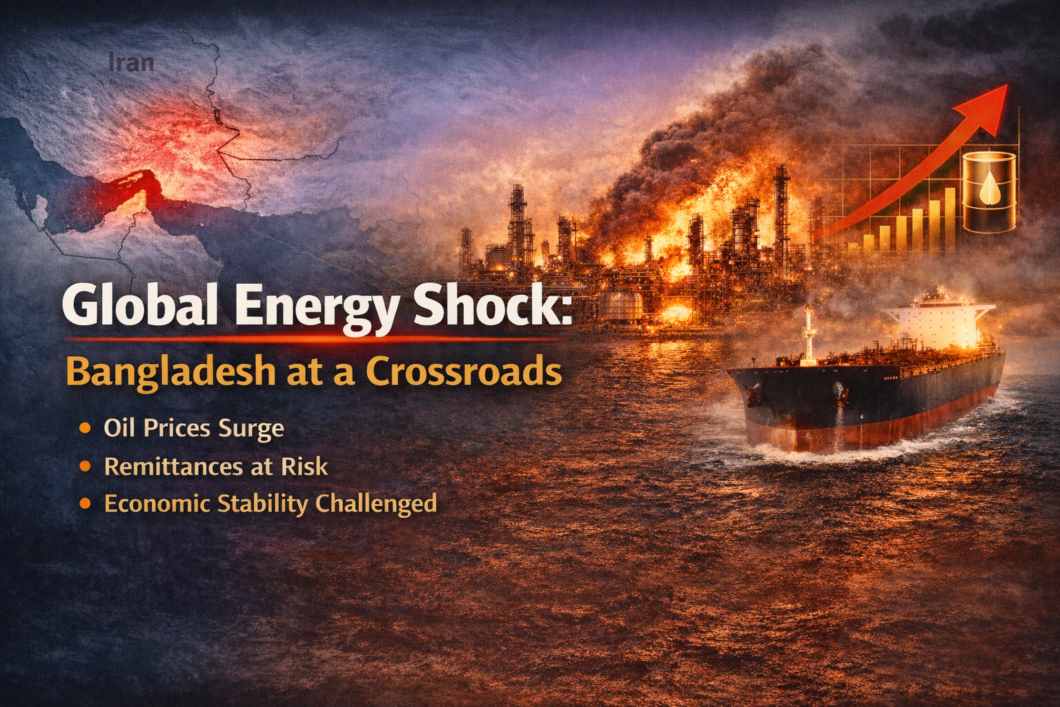
In 2026, the country’s democratic transition has coincided with a global geopolitical maelstrom, triggered by the US–Israel attack on Iran. The US’s attempt to decapitate the Iranian leadership and destabilize the regime appears to have backfired. Instead, the current regime remains firmly in control and has managed to transform the conflict into a broader regional war. Iranian ballistic missiles are now targeting not only Israeli cities and US bases in the Middle East but also impacting parts of the wider GCC region.
Oil well, refineries, airports, and seaports have been hit by Iranian ballistic missiles and drones across Qatar, Saudi Arabia, Kuwait, the UAE, and Bahrain, with significant repercussions for the global energy market. Most critically, Iran has obstructed the narrow Strait of Hormuz, a key chokepoint through which nearly 20% of global oil and LNG flows.
The third Gulf War has begun to reverberate across the global economy. Energy prices have surged, driven by expectations of short-term supply shortages. Brent crude is currently hovering around USD 100–108 per barrel, while derivative markets suggest a possible stabilization in the USD 80–95 range over the next 3–6 months. However, in an extreme scenario, if the conflict persists and transit through the Strait of Hormuz remains restricted, prices could exceed USD 150 per barrel, with severe implications for the global economy, particularly for emerging economies like Bangladesh.
What are the possible outcomes of the war?
Much will depend on how the conflict evolves, particularly whether the US and Iran can move toward de-escalation. A potential US ground invasion would significantly worsen the situation, prolonging the conflict and increasing geopolitical uncertainty. Continued attacks on energy infrastructure would likely disrupt supply in the short to medium term, pushing oil and LNG prices even higher.
Scenario 1: Negotiated settlement
The US has limited appetite for a prolonged war, given domestic economic pressures and the political risks associated with casualties, especially ahead of US’s mid-term elections. A significant segment of the “Make America Great Again” (MAGA) base of the republican party leans toward isolationism and views this largely as Israel’s war, favoring a swift resolution.
However, Israel may not be easily deterred and could continue its offensive, aiming to reshape the geopolitical landscape of the Middle East and displace the ruling regime. Ending the war within a 2–3-week timeframe would depend heavily on the US’s ability to restrain Israel and offer Iran meaningful concessions. At present, this scenario appears unlikely, given the administration’s mixed signaling and limited diplomatic overture.
Scenario 2: Partial de-escalation
Intermediaries may succeed in persuading both sides to scale back hostilities. Iran might reduce attacks on neighboring countries and partially ease restrictions in the Strait of Hormuz.
Even then, oil and gas prices are unlikely to stabilize fully. Sporadic attacks from either side could continue to trigger volatility in global energy markets.
Scenario 3: Ground invasion and regime change
A US ground invasion could attempt to force regime change in Iran, but at a very high human and economic cost. Even if the current regime were replaced, the aftermath could resemble Iraq, marked by prolonged instability and insurgency.
Regime change is unlikely to materialize quickly. The conflict could drag on for months, as the Iranian Revolutionary Guard continues to resist external forces.
Immediate challenges for policymakers
While policymakers may hope for a quick resolution under Scenario 1, it is critical to prepare for less favorable outcomes. The economic impact is likely to unfold across three fronts: (1) Higher energy prices; (2) Uncertainty in exports and remittance inflows; (3) Balance of payments and fiscal pressures.
Rising energy prices, if passed on to consumers, will fuel inflation and potentially slow economic growth. LNG shortages could lead to load shedding, disrupting manufacturing and increasing reliance on costly backup generation.
Historically, high energy prices have contributed to economic downturns in major economies. Bangladesh’s apparel exports could be affected if consumers in the EU and the US cut back on discretionary spending due to rising fuel costs.
The GCC region accounts for 60–65% of Bangladesh’s remittance inflows, with Saudi Arabia being the largest contributor. A prolonged conflict could slow economic activity in these countries, affecting employment and potentially forcing some migrant workers to return and leading to a decline in remittance inflows.
Bangladesh currently imports fuel worth USD 7–8 billion annually, including: LNG: USD 3.8–4 billion, Crude oil: USD 1 billion, and Furnace oil: USD 2–4 billion. A USD 10 increase in oil prices could add approximately USD 80 million to the import bill. Estimates suggest total fuel import costs could rise by up to 40%, reaching USD 10–12 billion annually if the conflict persists.
This combination of rising import costs and declining export/remittance inflows could widen the balance of payments deficit and put downward pressure on the BDT. Given Bangladesh’s dependence on imports for nearly 45% of essential goods, currency depreciation would further amplify inflationary pressures.
Fiscal constraints
The government has so far refrained from raising diesel and octane prices, likely to avoid triggering immediate inflationary shocks. To avoid immediate crises, the finance division has allocated BDT 17,000 million for LNG subsidies and BDT 7,000 million to BPC for oil subsidies. If high prices persist, additional subsidies may be required; further straining fiscal space, especially in the context of weak revenue growth.
Tackling the systemic challenge
Ensuring energy security is critical for sustaining Bangladesh’s growth trajectory. Unreliable energy supply will deter both domestic and foreign investment. Bangladesh must pursue medium-term strategies to reduce dependence on Middle Eastern energy supplies.
According to government estimates, unexplored natural gas reserves—both onshore and offshore—are in the range of 38–63 TCF. Even under conservative assumptions, these domestic reserves could cover 20–25 years of current demand. The government should actively explore opportunities to develop these resources in collaboration with international oil and gas companies by designing propositions that are commercially attractive and competitive.
Our long-term LNG suppliers remain concentrated, with Qatar accounting for 55–60% and Oman for 10–15%, while the remainder is procured from the spot market, primarily from Malaysia, Singapore, the US, and Brunei. This geographic concentration presents a clear risk. The government should work toward diversifying supply by building medium-term partnerships with a broader set of countries.
Our current fuel storage capacity stands at around 1.3–1.5 million tonnes, which translates to roughly 30–40 days of consumption. However, stock levels are significantly lower for critical fuels such as diesel (around 15 days) and petrol/octane (approximately 10–12 days). From an energy security perspective, there is an urgent need to invest in additional storage and refining capacity.
At present, our sole refinery, Eastern Refinery, has a processing capacity of 1.5 million tonnes per annum, which is insufficient relative to national demand. The planned second unit, with an additional capacity of 3 million tonnes per year, will need to be implemented in a timely manner, backed by appropriate capital allocation from the government. At the same time, policymakers should aim to expand storage capacity to build a strategic reserve covering 60–90 days of demand.
Investment in renewable energy, particularly solar parks and rooftop solar, can help Bangladesh gradually reduce its dependence on costly fossil fuels. The recent cancellation of LOIs for 34 solar projects (5,600 MW) by the power ministry has understandably shaken investor confidence, which the new government will need to actively restore. The national target remains to increase the share of renewables from 5% to 20% of total energy demand by 2030. Achieving this ambitious goal will require strong policy support, improved access to refinancing mechanisms, and significantly reduced bureaucratic barriers. In addition, manufacturing firms should be encouraged to accelerate decarbonization efforts by investing in energy-efficient machinery and processes.
Reviving energy security is of paramount importance if Bangladesh is to achieve its aspiration of becoming a developed economy by 2041. The current geopolitical turmoil triggered by the third Gulf War serves as a powerful wake-up call for policymakers, one that should ideally nudge us toward more resilient and forward-looking energy strategies.